|
English Lops
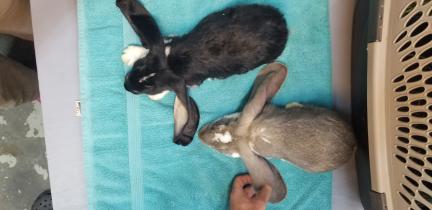
The contents of this page for English Lops is still under construction. Please check back.
As of today, May 9, 2026, I am a NEW English Lop Owner. I did not get out of bed thinking that I would buy English Lops today, but more than one of you reading this understands how this goes.
I was actually looking for Dwarf Hotots, a breed I have had several times in my life.
I AM THRILLED and Proud to be a New Owner of English Lops, and a THANK YOU to the Breeders at the Sedalia, MO Rabbit Show that took the time to talk to me and answer my questions on this LOVELY Breed.
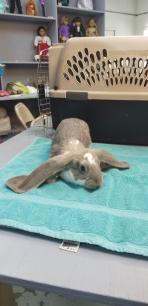 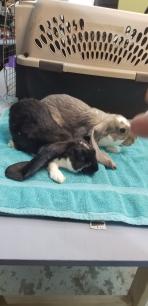
These are my new babies, 9.5 weeks old. I might like to Show my English Lops one day so I looked up and am sharing here, the Standard for the Breed = English Lop.
STANDARD FOR THE BREED = ENGLISH LOP
English Lop ARBA Standard
(Go by this guide when picking out an English Lop for show!)
English Lops are to be shown in two classifications: Broken and Solid Patterns.
Weights:
Senior Bucks; 8 months and older should be 9lbs and over
Senior Does; 8 months and older should be 10lbs and over
6/8 (Intermediate) Bucks; not over 10lbs
6/8 (Intermediate) Does; not over 11lbs
Junior Bucks and Does; under 6 months of age, not over 9lbs
- Juniors or intermediates over the weight limit may be shown in the higher age classes. But none shall be shown in lower age classes, no exceptions.
General balance and quality should be the influencing factors in judging merit and worth. Judging only on ears is to be avoided. English Lop ear growth, usually stops at about 4 months of age. Sometimes there is further development, as the skull grows. Measurement of the ears on the English Lop is to be taken from the tip of one ear, to the tip of the other ear. A yardstick is recommended for the most accurate measurements, and should be set just behind the base of the ears, resting on the neck. The ears should be stretched to their greatest span, and should not be folded. Measurement of width should be taken by opening the ear back, and be taken more than once to make sure of the widest point.
General Type: 35 Points
The body of the English Lop should have a well developed hindquarters, midsection and shoulders. The shoulders should blend in smoothly into the midsection, as should the midsection with the hindquarters. Chests should be full and rounded, with a very small dewlap for bucks. Does with a larger, well carried dewlap is permissible. English Lops should look similar to a mandolin in shape. The body top line should have a definite arch, starting at the back of the shoulders, with a smooth curve, rising to a high point over the middle of the back. The hips should be well rounded, completing the arch. When an English Lop is viewed from above, the sides of the rabbit should narrow off slightly, from the hindquarters to the shoulders.
Faults:
Lack of an arch, choppy hindquarters, short, compact body type, narrow shoulders, pinched or undercut hips. Poor flesh condition is also a common fault, as in a lot of rabbits at one point or another. Though it can be corrected by changing amounts of feed. If the arch starts directly behind the neck, it is bad, it should start where the shoulders end.
Head: 10 Points
The head should be well shaped, wide and thick. It should taper off slightly to a wide muzzle. The skull is to be medium length with a curvature when viewed in profile. The neck should be short. Pinched, narrow noses are a fault.
Ears: 33 Points
The ears are to be carried low on the head, there should be no noticeable crown. They should hang loose and close to the body. They also have a minimum length of 21 inches from tip to tip, and the width should be 1/4 of the total length of the ear. The longer the ear length, the better!
Substance and Shape of Ears:
The ears should be thick enough, so they are not torn easily. They should remain thin enough to maintain the longitudinal crease in the ear. Ears should be well rounded and wide at the tips.
Texture of Ears:
The ears should be very soft and smooth. They should be free of holes, tears and pimples.
Faults in Ears:
Pointy ears, are a fault, as well is a crown on the top of the head, between the ears.
Disqualifications in Ears:
Ears less then 21 inches in length. Tears, holes or excessive blemishes
Feet & Legs: 3 Points
Feet and legs should be straight and parallel to the body, with a good width between the hocks. Toenails on the broken pattern can be light or dark.
Bone: 4 Points
Bone should be medium to heavy and strong.
Faults in Bone/Feet/Legs:
Weak ankles; mismatched toenails on brokens
Disqualifications in Bone/Feet/Legs:
Light/thin bones, and wrong toenail colors.
Fur: 5 Points
The fur is the flyback type, and should be short, fine and silky to the touch. Should not be harsh or wooly. Fur should be close to the body.
Color & Markings: 4 Points
Brokens should have a nose marking (butterfly) eye circles, and dark colored ears. Blanket pattern is preffered over spotted pattern, and the color should start behind the head on the shoulders, and fill in over the back to the hips. Feet and legs should be white, with the exception of elbow spots. All Lops should refer to the Lop colored guide in the ARBA Standard of Perfection book to determine color. Eye color must match varierty and groups.
Faults:
Body and head patterns that don't conform with the general pattern description.
Disqualifications:
A complete absence of a head marking on broken pattern animals.
Condition: 6 Points (ARBA Definition)
The best condition is desired. A well groomed rabbit will always win over a stained one. Keep cages clean, to prevent urine stains, and groom often to comb out loose hairs and to keep coats in condition.
-- The Rabbit Agility Team
Sat, 09 May 2026 19:59:17 +0000
| 




 In the high plains of South Dakota, USA